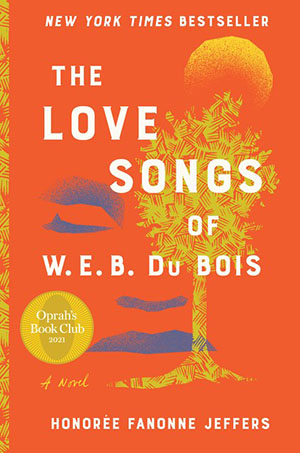
 The Love Songs of W.E.B. Du Bois: A Novel by Honoree Fanonne Jeffers
Publication Date: August 24, 2021
Pages: 816
Add on: Goodreads
Buy the Book: Amazon
Rating: ★★★★★
Source: From the Publisher
Genre: Fiction / African American & Black / Women
Publisher: Harper / HarperCollins
The award-winning poet and essayist makes her fiction debut with this magisterial epic—an intimate yet sweeping novel with the freshness and forcefulness of Homegoing, The Turner House, and The Water Dancer —that chronicles the journey of one American family from the centuries of the colonial slave trade through the Civil War to our own tumultuous time.
“My life had its significance and its only deep significance because it was part of a Problem,” W. E. B. Du Bois once wrote. Since childhood, Ailey Pearl Garfield has understood these words all too well. Bearing the names of two formidable Black Americans—the revered choreographer Alvin Ailey and her great grandmother, the descendant of slaves and tenant farmers—Ailey carries the weight of this Problem on her shoulders.
The daughter of an accomplished doctor and a strict schoolteacher, Ailey is raised in the City but spends summers in the small Georgia town of Chicasetta, where her mother’s family has lived since their ancestors arrived from Africa in bondage. Growing up, she struggles with this duality, a battle for belonging that shapes her identity. On one side are her exacting parents and her imperious, light-skinned grandmother Nana Claire, to whom skin color is paramount. On the other, Ailey feels the pull of the “deep country” of her mother’s land-tending family, whose forebears endured the horrors of slavery and Jim Crow.
But how can Ailey live up to everyone’s expectations when half of her family rejects the truth of a fraught racial history, while the rest can’t ever seem to break away from it?
To come to terms with who she is and what she wants, Ailey embarks on a journey through her family’s past, uncovering shocking and unexpected tales of generations of ancestors—Black, Indigenous, and white—in the deep South. In doing so Ailey must learn to embrace her full heritage, a legacy of oppression and resistance, bondage and independence, cruelty and resilience that is the story of the Black experience in America itself.
REVIEW
Honore Fanonne Jeffers’s The Love Songs of W.E.B. Du Bois isn’t just a novel; it’s a full, sprawling universe, alive with memory and haunted by the American South’s long and tangled past. At its heart is Ailey Pearl Garfield, a young Black woman who grows up in the late twentieth century, always aware that her story is stitched together from the struggles and triumphs of generations before her. The fictional town of Chicasetta, Georgia, becomes the center of gravity for a family whose roots wind through African American, Creek, and Scottish ancestry.
Ailey’s journey is both personal and epic. She’s a girl who loves her sisters fiercely, especially Lydia, whose battles with addiction cast long shadows over the family. But as Ailey makes her way through school, family gatherings, and the simple rituals of Southern life, she’s also drawn to the stories her elders tell and the secrets they keep. The novel shifts between Ailey’s present and the “love songs”, lyrical, almost mythic vignettes that reach back through eight generations, tracing her family’s line from the era before slavery, through the horrors of bondage, Jim Crow, and into the modern day.
Jeffers brings an entire cast of characters to life, from the enslaved woman Kine and her daughter Beauty to the land-stealing settlers and the matriarchs who hold the family together. These ancestors aren’t just names in a history book; they’re living, breathing presences, shaping Ailey’s sense of self and her understanding of what it means to belong. There’s an almost supernatural thread running through the book, too: a ghostly “long-haired lady” who visits Ailey in dreams, tying her to the women who came before her and suggesting that the past never really lets go.
The themes here are as wide-ranging as the story itself: family, identity, education, racism, resilience, and the pain that can echo through generations. Jeffers doesn’t flinch from the harshest parts of American history, the violence of stolen land, the brutality of slavery, sexual and physical abuse, and the ugly realities of colorism and class divides within Black communities. Yet, there’s always a current of hope and endurance, a celebration of the ways Black women in particular have survived and kept their stories alive.
Jeffers’s background as a poet shines through in every line. The writing is lush and musical, full of sensory detail and emotional honesty. She weaves together different voices, times, and perspectives with impressive precision, especially given the novel’s nearly 800-page sweep. If the book asks a lot of its readers: patience, attention, a willingness to sit with pain, it gives back even more. There are passages where the prose almost sings, capturing the beauty and terror of the South, the weight of inheritance, and the joy that can spark even in the hardest lives.
Comparisons to Toni Morrison aren’t just convenient; they’re earned. Like Morrison in Beloved, Jeffers uses fiction to reach back, to reclaim the voices of those history tried to silence. She offers no easy answers, but she does offer reckoning and, ultimately, a sense of possibility. The Love Songs of W.E.B. Du Bois is sweeping and forceful, a new contender for the title of Great American Novel. Some readers will find the size and emotional heft intimidating, but most are likely to agree that the novel’s ambition and heart are more than worth the effort.
The Love Songs of W.E.B. Du Bois is a monumental achievement: lyrical, raw, honest, and full of the kind of deep-seated wisdom that only comes from truly listening to the past. Jeffers gives us a portrait of Black identity and American history that refuses to be neat or simple. It’s a demanding read, yes, but also an unforgettable one, perfect for anyone who wants to understand not just where we come from, but how we carry those stories forward.
Rating: ★★★★ out of 5
